
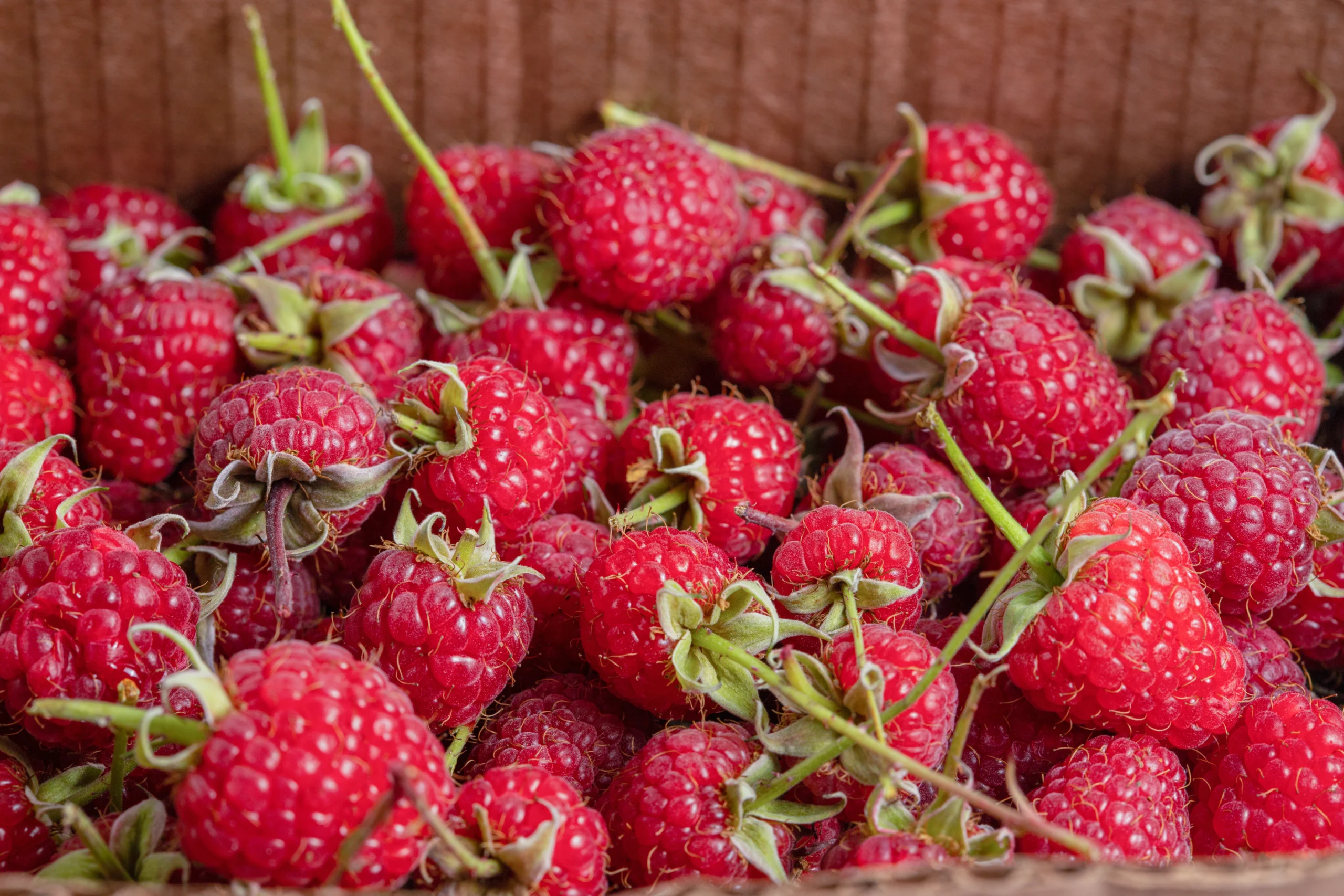
Raspberries are a popular fruit known for their vibrant color and sweet-tart flavor, belonging to the genus Rubus in the rose family. They’re not only delicious but also packed with nutrients and antioxidants.
Basic Information
- Common Name: Raspberries
- Scientific Name: Rubus idaeus (most common species)
- Category: Fruit
- Varieties: There are several varieties of raspberries, including red, black, purple, and golden raspberries. Each variety has a slightly different flavor profile and growth habit.
Nutritional Information
- Macronutrients: Raspberries are low in calories and fat, and high in dietary fiber. A 100-gram serving of raw raspberries contains approximately 12.9 grams of carbohydrates, 1.01 grams of protein, and 0.19 grams of fat.
- Micronutrients: They are an excellent source of vitamin C, manganese, and dietary fiber. They also contain vitamin K, vitamin E, magnesium, folate, omega-3 fatty acids, and potassium.
Phytonutrients
Raspberries are not only celebrated for their vibrant flavor but also for their rich content of phytonutrients, which contribute significantly to their health benefits. These bioactive compounds offer antioxidant, anti-inflammatory, and potentially anti-cancer properties. Here’s an overview of the key phytonutrients found in raw raspberries:
1. Anthocyanins
- Presence: These are the pigments that give red raspberries their characteristic color. Anthocyanins are particularly abundant in raspberries, with cyanidin-3-glucoside being the most prevalent.
- Benefits: Anthocyanins have strong antioxidant properties, helping to protect cells from damage by free radicals. They’ve been associated with a reduced risk of heart disease, improved vascular health, and anti-cancer effects.
2. Ellagitannins and Ellagic Acid
- Presence: Raspberries are a rich source of ellagitannins, particularly sanguiin H-6 and lambertianin C. These compounds are hydrolyzed into ellagic acid in the body.
- Benefits: Both ellagitannins and ellagic acid have been studied for their anti-cancer properties, including the ability to inhibit tumor growth and induce apoptosis in cancer cells. They also possess antioxidant and anti-inflammatory effects.
3. Quercetin
- Presence: This flavonoid is found in smaller amounts in raspberries.
- Benefits: Quercetin has antioxidant, anti-inflammatory, and antihistamine properties, which may contribute to reducing the risk of certain diseases, including heart conditions and allergies.
4. Catechins
- Presence: Catechins, a type of flavonoid also found in green tea, are present in raspberries.
- Benefits: They have antioxidant properties and have been associated with heart health benefits, including improved blood flow and reduced blood pressure.
5. Vitamin C
- Presence: While not a phytonutrient, vitamin C is a powerful antioxidant found in high levels in raspberries.
- Benefits: It supports the immune system, skin health, and collagen synthesis, and works synergistically with other phytonutrients to enhance their antioxidant activity.
6. Salicylic Acid
- Presence: Raspberries contain salicylic acid, the natural form of aspirin.
- Benefits: It has anti-inflammatory properties and may contribute to the pain-relieving effects associated with consuming foods containing this compound.
Nutritional Synergy
The phytonutrients in raspberries, along with their vitamins, minerals, and fiber, work together to provide a synergistic effect that enhances their health benefits. This combination not only contributes to the fruit’s anti-inflammatory and antioxidant properties but may also offer protective effects against various chronic diseases, including cardiovascular disease, diabetes, obesity, and cancer.
Conclusion
Raspberries are a nutrient-dense food rich in phytonutrients that contribute to their health benefits and protective properties. Incorporating raspberries into the diet can provide a delicious way to consume a variety of bioactive compounds that support overall health.
Calorie Count and Glycemic Index
- Calorie Count: A 100-gram serving has only about 51 calories.
- Glycemic Index: Raspberries have a low glycemic index, making them suitable for a low-GI diet.
Physical Characteristics
- Color: Raspberries can be red, black, purple, or golden, depending on the variety.
- Shape: They are composed of many small drupelets clustered around a central core.
- Size: Each raspberry measures about 1.5 to 2 centimeters in diameter.
- Texture: Raspberries have a soft, slightly hairy texture. The fruit is juicy and the seeds are noticeable but edible.
Culinary Uses
- Common Dishes: Raspberries are versatile in the kitchen. They can be eaten fresh, added to salads, desserts, jams, jellies, and sauces, or used in baking.
- Preparation Methods: Can be used fresh or cooked. When cooking, raspberries can be pureed and strained to remove seeds for smooth sauces or coulis.
- Suitable Pairings: Raspberries pair well with chocolate, cream, other berries, lemon, and mint. They are also enhanced by a touch of sugar or honey.
Geographical Information
- Origin: Raspberries are believed to have originated in Eastern Asia. They have been consumed by humans since prehistoric times and were widely distributed in the wild across Europe and North America.
- Primary Growing Regions: Today, raspberries are cultivated worldwide, with major producers including Russia, the United States (particularly in the Pacific Northwest and California), Poland, Germany, and Chile.
- Seasonal Availability: While raspberries are typically harvested in the summer, advancements in cultivation and greenhouse technology have made them available year-round in many parts of the world.
Raspberries are cherished not just for their delightful flavor but also for their nutritional benefits, making them a valuable addition to a healthy diet. Their low calorie and high nutrient profile support various health benefits, from improved digestion to potential protection against certain diseases.
| proximates: | |
| Water | 85.6 g |
| Energy (Atwater General Factors) | 57 kcal |
| Energy (Atwater Specific Factors) | 51 kcal |
| Nitrogen | 0.16 g |
| Protein | 1.01 g |
| Total lipid (fat) | 0.19 g |
| Ash | 0.35 g |
| Carbohydrates: | |
| Carbohydrate, by difference | 12.9 g |
| Sugars, Total | 2.68 g |
| Sucrose | <0.25 g |
| Glucose | 0.99 g |
| Fructose | 1.68 g |
| Lactose | <0.25 g |
| Maltose | <0.25 g |
| Galactose | <0.1 g |
| Organic acids: | |
| Citric acid | 1740 mg |
| Malic acid | 54 mg |
| Oxalic acid | <40 mg |
| Pyruvic acid | <40 mg |
| Quinic acid | <40 mg |
| Minerals: | |
| Calcium, Ca | 16 mg |
| Iron, Fe | 0.45 mg |
| Magnesium, Mg | 19.2 mg |
| Phosphorus, P | 27 mg |
| Potassium, K | 156 mg |
| Sodium, Na | <2.5 mg |
| Zinc, Zn | 0.22 mg |
| Copper, Cu | 0.053 mg |
| Manganese, Mn | 0.494 mg |
| Vitamins and Other Components: | |
| Vitamin C, total ascorbic acid | 23 mg |
| Biotin | 3.43 µg |