
Bacon, especially when prepared in a restaurant setting, is a beloved breakfast staple and a versatile ingredient in many culinary creations. Here’s a detailed look into the specifics of cured, cooked bacon, with a focus on restaurant-prepared bacon.
Basic Information
- Common Name: Bacon
- Scientific Name: Derived from the domestic pig (Sus scrofa domesticus)
- Category: Meat (Pork)
- Varieties: There are several types of bacon, which vary based on the cut of pork used and the curing process. These include side bacon (most common in the United States), back bacon (popular in the UK and Canada), and others like pancetta (Italian bacon) and speck (a type of smoked bacon from Italy and Austria).
Nutritional Information
- Macronutrients: Bacon is high in fat, with a significant amount of protein and very few carbohydrates. In a typical serving of cooked bacon (about 20g or roughly 2 slices), there are approximately 36.5g of fat, 40.9g of protein, and 2.1g of carbohydrates.
- Micronutrients: Bacon provides certain B vitamins (B1, B2, B3, B5, B6, and B12), phosphorus, selenium, and zinc. However, it is also high in sodium and cholesterol.
Phytonutrients
When discussing the phytonutrients present in animal-based foods like pork bacon, it’s important to clarify that phytonutrients, by definition, are compounds found in plants. These compounds contribute to the plant’s color, flavor, and resistance to disease, among other functions. Animals, including humans, can benefit from consuming phytonutrients through a plant-based diet, as these compounds offer various health benefits, including antioxidant and anti-inflammatory effects. Since bacon is an animal product, it does not contain phytonutrients. However, bacon does provide certain nutrients and compounds as a result of the pig’s diet, as well as from the curing and cooking processes. Let’s explore the nutritional aspects of pork bacon, particularly those related to its curing and cooking:
Nutritional Components in Cured, Cooked Bacon
- Proteins and Amino Acids: As with other meats, bacon is a good source of protein, providing essential amino acids necessary for muscle repair and growth.
- Fats: Bacon is high in saturated fats and also contains monounsaturated fats, including oleic acid, which is also found in olive oil.
- Vitamins: It offers some B vitamins, particularly vitamin B1 (thiamine), B2 (riboflavin), B3 (niacin), B5 (pantothenic acid), B6, and B12, which are important for energy production and brain health.
- Minerals: Provides minerals such as phosphorus, selenium, zinc, and iron, which play various roles in bone health, antioxidant defenses, immune function, and oxygen transport in the blood, respectively.
Compounds from Curing and Cooking
- Nitrates and Nitrites: Used in the curing process, these compounds can convert into nitrosamines during cooking, particularly at high temperatures. While nitrosamines have been associated with an increased risk of certain cancers in animal studies, the risk associated with consuming cured meats like bacon is still a matter of ongoing research.
- Heterocyclic Amines (HCAs) and Polycyclic Aromatic Hydrocarbons (PAHs): These compounds can form when meat is cooked at high temperatures, especially during processes like frying or grilling. Like nitrosamines, they have been linked to an increased risk of cancer.
Health Considerations
The consumption of cured meats like bacon has been associated with various health risks, primarily due to the high content of saturated fats, sodium, and potentially harmful compounds formed during the curing and cooking processes. The World Health Organization has classified processed meats as carcinogenic to humans, based on evidence linking them to colorectal cancer.
While bacon does not contain phytonutrients, understanding the nutrients and compounds it does provide can help individuals make informed dietary choices. Enjoying bacon in moderation, as part of a balanced diet that includes a variety of plant-based foods rich in phytonutrients, can help mitigate some of the health risks associated with its consumption.
Calorie Count and Glycemic Index
- Calorie Count: A serving of cooked bacon contains about 501 calories.
- Glycemic Index: Bacon has a negligible glycemic index due to its minimal carbohydrate content.
Physical Characteristics
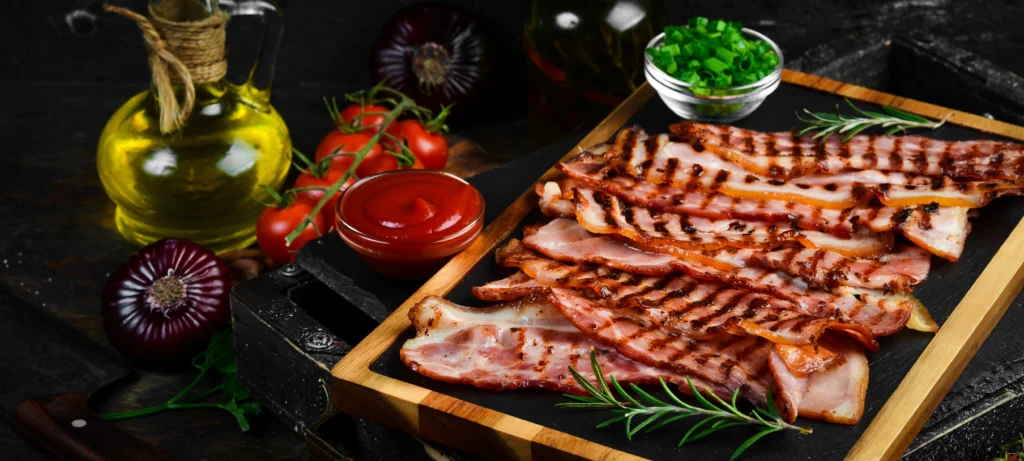
- Color: Cooked bacon is typically golden brown to deep brown, depending on the cooking time and method.
- Shape: Bacon slices are long and thin, with a characteristic striping of fat and meat.
- Size: Each slice of bacon is usually about one millimeter thick and can vary in length but is generally around 6 to 8 inches.
- Texture: When cooked, bacon is crispy on the outside with a tender, fatty interior.
Culinary Uses
- Common Dishes: Bacon is famed for its role in breakfast dishes but is also widely used in burgers, salads (like the classic BLT), and as a flavor enhancer in soups and stews.
- Preparation Methods: Bacon is most commonly pan-fried, but it can also be baked, grilled, or broiled. Restaurant bacon is often cooked on a flat-top grill, giving it a uniformly crispy texture.
- Suitable Pairings: Bacon pairs well with eggs, bread, tomatoes, lettuce, and avocado. It also complements the flavors of maple syrup, chicken, and pasta.
Geographical Information
- Origin: The practice of curing pork belly to make bacon dates back thousands of years, with various cultures developing their own methods.
- Primary Growing Regions: Today, pork is globally produced, with China, the European Union, and the United States being the largest producers of pork and, consequently, bacon.
- Seasonal Availability: Bacon is available year-round due to modern preservation techniques.
Bacon, with its rich flavor and versatile use, remains a staple in cuisines worldwide. Its nutritional profile makes it a high-fat, high-protein food, best enjoyed in moderation within a balanced diet. Whether featured in a classic breakfast plate, wrapped around dates for an appetizer, or crumbled over salads for added crunch and flavor, bacon continues to delight palates across the globe.
| proximates: | |
| Water | 14.2 g |
| Energy (Atwater General Factors) | 501 kcal |
| Energy (Atwater Specific Factors) | 512 kcal |
| Nitrogen | 6.54 g |
| Protein | 40.9 g |
| Total lipid (fat) | 36.5 g |
| Total fat (NLEA) | 34.6 g |
| Ash | 6.33 g |
| Carbohydrates: | |
| Carbohydrate, by difference | 2.1 g |
| Sugars, Total | 3.14 g |
| Sucrose | 3.09 g |
| Glucose | 0.04 g |
| Fructose | 0.01 g |
| Minerals: | |
| Calcium, Ca | 13 mg |
| Iron, Fe | 1.28 mg |
| Magnesium, Mg | 36.5 mg |
| Phosphorus, P | 415 mg |
| Potassium, K | 557 mg |
| Sodium, Na | 1830 mg |
| Zinc, Zn | 3.56 mg |
| Copper, Cu | 0.13 mg |
| Manganese, Mn | 0.02 mg |
| Lipids: | |
| Fatty acids, total saturated | 12.6 g |
| SFA 4:0 | 0.002 g |
| SFA 6:0 | 0.001 g |
| SFA 8:0 | 0.006 g |
| SFA 10:0 | 0.033 g |
| SFA 12:0 | 0.03 g |
| SFA 14:0 | 0.476 g |
| SFA 15:0 | 0.018 g |
| SFA 16:0 | 7.94 g |
| SFA 17:0 | 0.096 g |
| SFA 18:0 | 3.9 g |
| SFA 20:0 | 0.072 g |
| SFA 22:0 | 0.014 g |
| SFA 24:0 | 0.002 g |
| Fatty acids, total monounsaturated | 15.8 g |
| MUFA 12:1 | 0.001 g |
| MUFA 14:1 c | 0.009 g |
| MUFA 16:1 c | 0.839 g |
| MUFA 17:1 | 0.094 g |
| MUFA 17:1 c | 0.094 g |
| MUFA 18:1 c | 14.6 g |
| MUFA 20:1 c | 0.285 g |
| MUFA 22:1 c | 0.009 g |
| MUFA 22:1 n-9 | 0.005 g |
| MUFA 22:1 n-11 | 0.003 g |
| MUFA 24:1 c | 0.001 g |
| Fatty acids, total polyunsaturated | 6 g |
| PUFA 18:2 c | 5.27 g |
| PUFA 18:2 n-6 c,c | 5.23 g |
| PUFA 18:2 CLAs | 0.042 g |
| PUFA 18:3 c | 0.239 g |
| PUFA 18:3 n-3 c,c,c (ALA) | 0.227 g |
| PUFA 18:3 n-6 c,c,c | 0.012 g |
| PUFA 20:2 c | 0.214 g |
| PUFA 20:2 n-6 c,c | 0.214 g |
| PUFA 20:3 c | 0.074 g |
| PUFA 20:3 n-3 | 0.032 g |
| PUFA 20:3 n-6 | 0.042 g |
| PUFA 22:3 | 0.001 g |
| PUFA 20:4 | 0.16 g |
| PUFA 20:4c | 0.16 g |
| PUFA 20:5c | 0.003 g |
| PUFA 20:5 n-3 (EPA) | 0.003 g |
| PUFA 22:2 | 0.003 g |
| PUFA 22:5 c | 0.024 g |
| PUFA 22:4 | 0.047 g |
| PUFA 22:5 n-3 (DPA) | 0.024 g |
| PUFA 22:6 c | 0.006 g |
| PUFA 22:6 n-3 (DHA) | 0.006 g |
| Fatty acids, total trans | 0.15 g |
| Fatty acids, total trans-monoenoic | 0.126 g |
| TFA 14:1 t | 0.001 g |
| TFA 16:1 t | 0.007 g |
| TFA 18:1 t | 0.118 g |
| Fatty acids, total trans-dienoic | 0.024 g |
| TFA 18:2 t not further defined | 0.024 g |