
Onion rings, particularly those that are breaded, par-fried, frozen, and then prepared by heating in an oven, offer a unique profile when analyzing their attributes across various dimensions. Below is a detailed exploration based on the aspects you’re interested in:
Basic Information
- Common Name: Onion Rings
- Scientific Name: Not applicable as this is a prepared food product rather than a singular biological species.
- Category: Prepared food, specifically a side dish or appetizer.
Nutritional Information
For a typical serving size of 8-9 onion rings:
- Macronutrients:
- Carbohydrates: Approximately 36.3 grams, primarily from the breading.
- Proteins: Roughly 4.52 grams, a minor amount coming from the onion and breading.
- Fats: About 14.4 grams, significantly varying with the breading and frying oil.
- Micronutrients:
- Onion rings may provide minor amounts of vitamins like Vitamin C and B-vitamins from the onions, though these are not significant due to the small quantity of onion and the processing involved.
- Minerals may include traces of iron and calcium, mostly from the enriched flour used in the breading.
Phytonutrients
Phytonutrients are compounds found in plants that have various health benefits. In the context of onion rings, particularly those that are breaded, par-fried, frozen, and then heated in an oven, the phytonutrient content is affected by several factors including the preparation process, the type of onion used, and the ingredients in the breading. However, the processing methods and the fact that onion rings are a prepared food item significantly reduce the concentration of these beneficial compounds compared to fresh vegetables. Here’s an overview of the types of phytonutrients that might still be present in onion rings, though in minimal amounts:
Phytonutrients in Onion Rings
- Quercetin: Onions are a rich source of quercetin, a type of flavonoid that has antioxidant properties. However, the amount in onion rings would be lower than in fresh onions due to the cooking and processing.
- Sulfur Compounds: Onions contain various sulfur-containing compounds, which are responsible for their pungent aroma and potential health benefits, including anti-inflammatory and antimicrobial effects. These compounds might be reduced in onion rings due to the frying process.
- Anthocyanins: If the onion rings are made from red onions, they could contain anthocyanins, another type of flavonoid with antioxidant properties. The content would be significantly lower than in raw onions and may be affected by the high temperatures used in cooking.
- Other Flavonoids: Apart from quercetin, onions have other flavonoids like isorhamnetin and kaempferol, though their presence in onion rings would be minimal.
Impact of Processing on Phytonutrients
- Heat and Cooking: The process of par-frying and then heating in the oven can reduce the concentration of phytonutrients due to the degradation of these compounds at high temperatures.
- Freezing: Freezing can also affect the phytonutrient content, though the impact is less severe compared to heat. Some phytonutrients may degrade over time in frozen storage.
- Breading: The breading and additional ingredients in onion rings primarily contribute calories from fats and carbohydrates, with little to no added phytonutrients. In fact, the breading can absorb oil during frying, reducing the overall nutritional profile of the vegetable component.
Considering these factors, while onion rings can contain trace amounts of phytonutrients from the onions, the levels are significantly lower than what you would find in fresh, unprocessed onions. For those looking to maximize their intake of phytonutrients, consuming fresh vegetables and fruits is the most effective approach. Onion rings should be enjoyed as an occasional treat rather than a primary source of nutritional benefits.
Calorie Count and Glycemic Index
- Calorie Count: A serving of onion rings can contain approximately 289 calories, primarily from the fats and carbohydrates.
- Glycemic Index: Being a fried and breaded product, it would have a high glycemic index, but specific numbers would depend on the exact preparation and ingredients.
Physical Characteristics
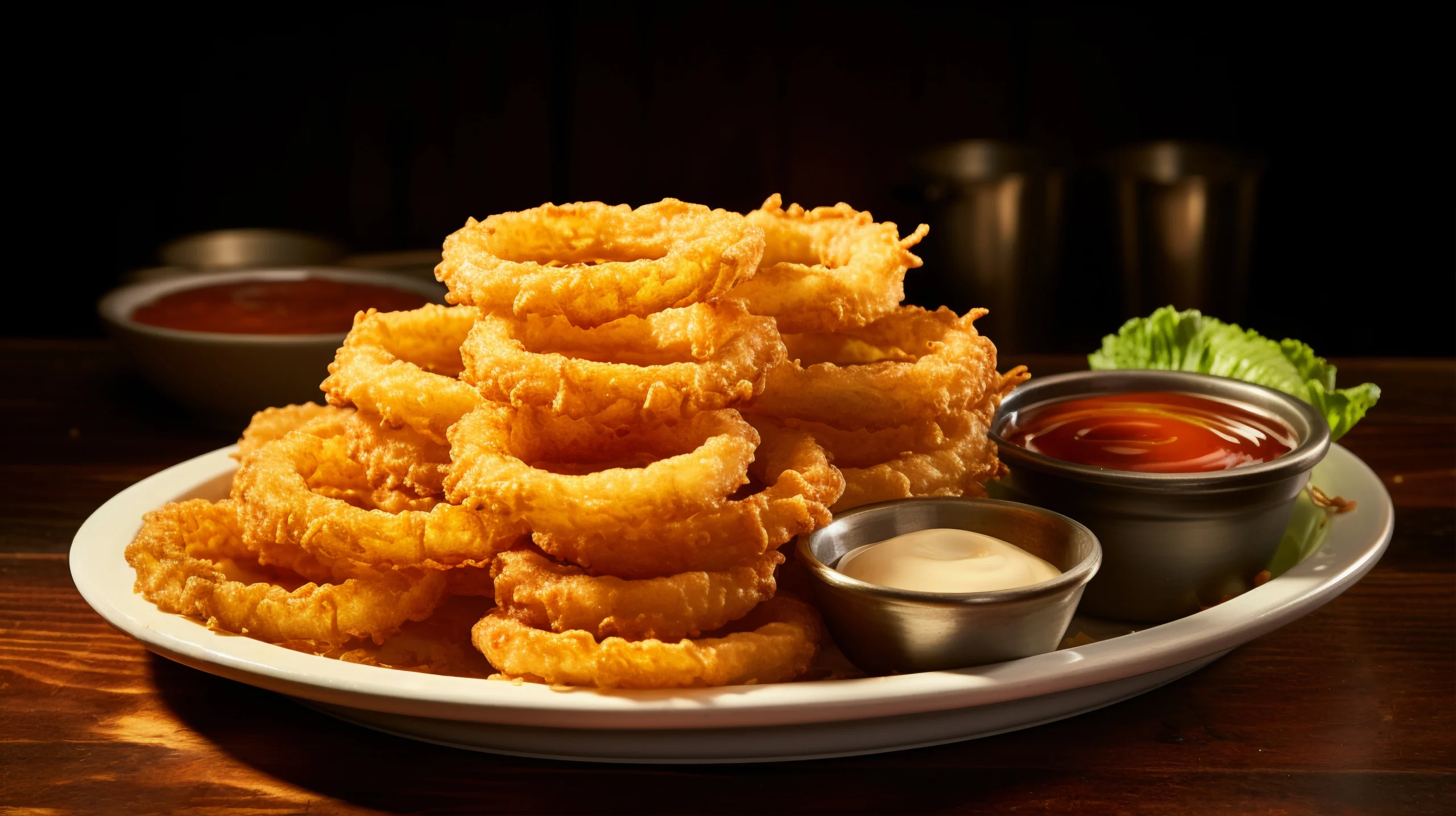
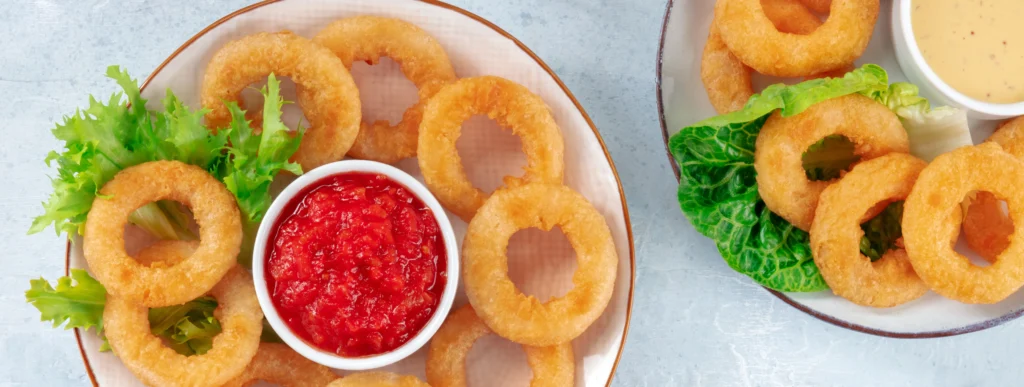
- Color: Golden brown, a result of the breading being fried or baked.
- Shape: Circular rings, mirroring the cross-sectional shape of the onion.
- Size: Typically 2-4 inches in diameter, varying with the size of the onion used.
- Texture: Crispy exterior due to the breading, with a tender interior from the onion.
Culinary Uses
- Common Dishes: Often served as a side dish with burgers, sandwiches, or as an appetizer with various dipping sauces.
- Preparation Methods: Although these onion rings are pre-prepared, the final step involves heating them in an oven until they are crispy and golden.
- Suitable Pairings: Commonly paired with ketchup, ranch dressing, or any sauce with a tangy profile to complement the sweetness of the onion.
Geographical Information
- Origin: The concept of fried onions is global, but the American-style breaded onion ring is believed to have originated in the United States.
- Primary Growing Regions: As a processed food product, it’s not about the growing regions of the onions themselves but rather where these products are manufactured, which is widespread across countries with developed food processing industries.
- Seasonal Availability: Frozen, prepared onion rings are available year-round due to their processed nature.
This overview gives a comprehensive look at onion rings in their breaded, par-fried, and oven-heated form, from their basic identity and nutritional makeup to their culinary role and geographical roots.
| proximates: | |
| Water | 43.4 g |
| Energy (Atwater General Factors) | 293 kcal |
| Energy (Atwater Specific Factors) | 289 kcal |
| Nitrogen | 0.74 g |
| Protein | 4.52 g |
| Total lipid (fat) | 14.4 g |
| Total fat (NLEA) | 12.6 g |
| Ash | 1.44 g |
| Carbohydrates: | |
| Carbohydrate, by difference | 36.3 g |
| Carbohydrate, by summation | 34 g |
| Fiber, total dietary | 2.4 g |
| Sugars, Total | 4.5 g |
| Sucrose | 1.34 g |
| Glucose | 1.2 g |
| Fructose | 1.21 g |
| Lactose | 0.03 g |
| Maltose | 0.71 g |
| Starch | 27.2 g |
| Minerals: | |
| Calcium, Ca | 28 mg |
| Iron, Fe | 1.14 mg |
| Magnesium, Mg | 20.4 mg |
| Phosphorus, P | 75 mg |
| Potassium, K | 135 mg |
| Sodium, Na | 374 mg |
| Zinc, Zn | 0.59 mg |
| Copper, Cu | 0.081 mg |
| Manganese, Mn | 0.435 mg |
| Selenium, Se | 5.6 µg |
| Vitamins and Other Components: | |
| Vitamin C, total ascorbic acid | 1.6 mg |
| Thiamin | 0.196 mg |
| Riboflavin | 0.116 mg |
| Niacin | 1.57 mg |
| Pantothenic acid | 0.302 mg |
| Vitamin B-6 | 0.127 mg |
| Folate, total | 31 µg |
| Choline, total | 10.7 mg |
| Choline, free | 4.9 mg |
| Choline, from phosphocholine | 0.5 mg |
| Choline, from phosphotidyl choline | 3.3 mg |
| Choline, from glycerophosphocholine | 2 mg |
| Betaine | 36.4 mg |
| Vitamin E (alpha-tocopherol) | 0.57 mg |
| Tocopherol, beta | 0.98 mg |
| Tocopherol, gamma | 3.47 mg |
| Tocopherol, delta | 1.96 mg |
| Tocotrienol, beta | 0.2 mg |
| Lipids: | |
| Fatty acids, total saturated | 2.15 g |
| SFA 8:0 | 0.006 g |
| SFA 10:0 | 0.012 g |
| SFA 12:0 | 0.005 g |
| SFA 14:0 | 0.011 g |
| SFA 15:0 | 0.004 g |
| SFA 16:0 | 1.45 g |
| SFA 17:0 | 0.014 g |
| SFA 18:0 | 0.559 g |
| SFA 20:0 | 0.036 g |
| SFA 22:0 | 0.04 g |
| SFA 24:0 | 0.015 g |
| Fatty acids, total monounsaturated | 2.87 g |
| MUFA 16:1 c | 0.012 g |
| MUFA 17:1 | 0.007 g |
| MUFA 17:1 c | 0.007 g |
| MUFA 18:1 c | 2.81 g |
| MUFA 20:1 | 0.041 g |
| MUFA 20:1 c | 0.041 g |
| Fatty acids, total polyunsaturated | 7.58 g |
| PUFA 18:2 c | 6.66 g |
| PUFA 18:2 n-6 c,c | 6.66 g |
| PUFA 18:2 CLAs | 0.004 g |
| PUFA 18:3 c | 0.906 g |
| PUFA 18:3 n-3 c,c,c (ALA) | 0.859 g |
| PUFA 18:3 n-6 c,c,c | 0.047 g |
| PUFA 20:2 c | 0.003 g |
| PUFA 20:2 n-6 c,c | 0.003 g |
| PUFA 20:4 | 0.005 g |
| PUFA 20:4c | 0.005 g |
| Fatty acids, total trans | 0.041 g |
| Fatty acids, total trans-monoenoic | 0.01 g |
| TFA 18:1 t | 0.008 g |
| TFA 22:1 t | 0.001 g |
| Fatty acids, total trans-dienoic | 0.032 g |
| TFA 18:2 t not further defined | 0.032 g |