

Basic Information
- Name: Kale
- Scientific Name: Brassica oleracea var. sabellica
- Category: Vegetable, Leafy Green
Varieties
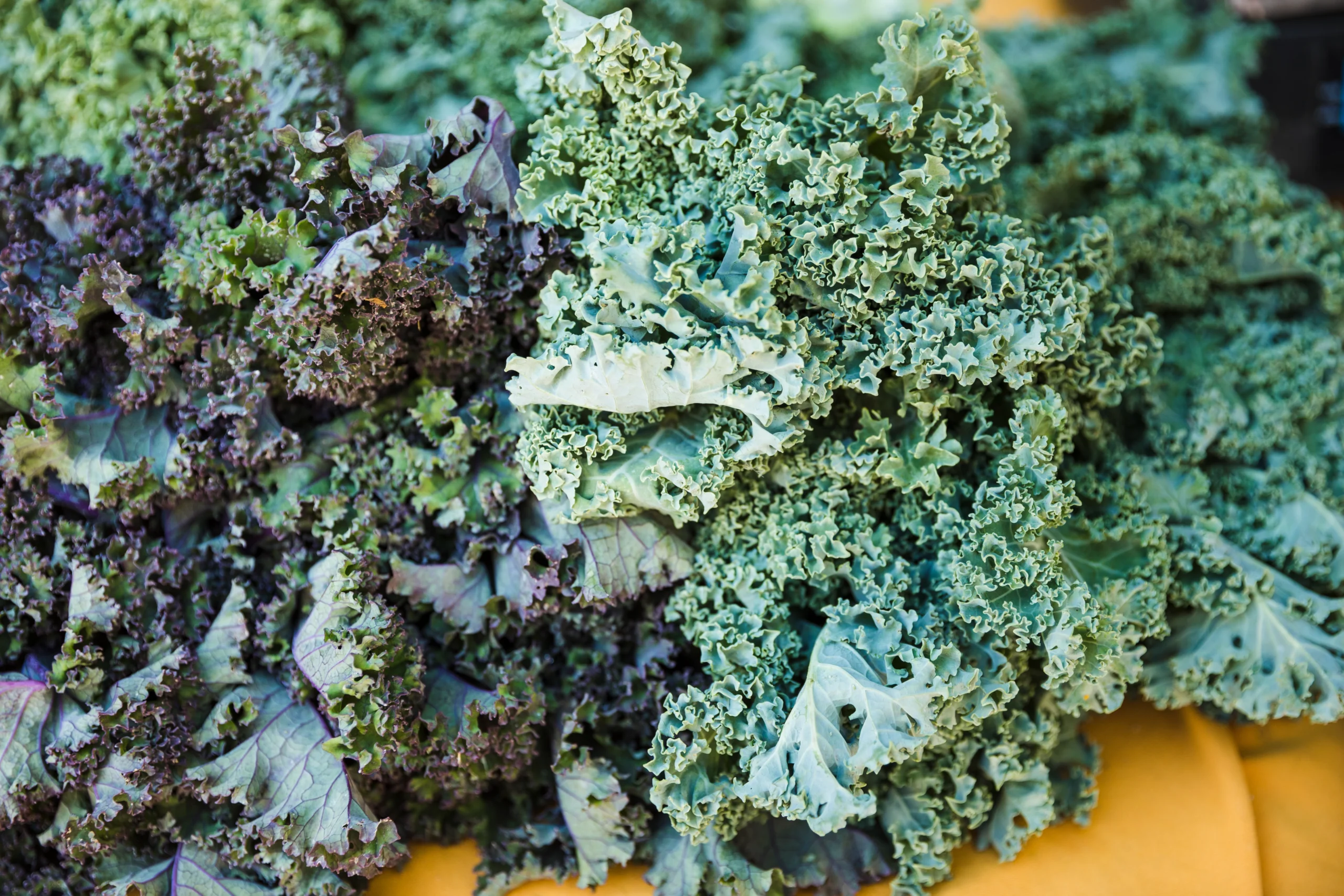
Kale comes in several varieties, each with unique characteristics:
- Curly Kale: Recognizable by its vibrant green, curly leaves. It has a pungent flavor with peppery and bitter notes.
- Lacinato Kale (also known as Dinosaur Kale or Tuscan Kale): Features dark blue-green leaves with a slightly sweeter and more delicate taste than curly kale.
- Red Russian Kale: Has flat, fringed leaves that are green-gray with purple stems. It’s slightly sweet and mild in flavor.
- Siberian Kale: Less common, with broad, flat leaves that are more tender and mild in flavor compared to other types.
Nutritional Information
- Macronutrients:
- Carbohydrates: About 4.42 g per 100 g, mainly from dietary fiber.
- Proteins: Approximately 2.92 g per 100 g.
- Fats: Negligible, around 1.49 g per 100 g.
- Micronutrients: High in Vitamin A, Vitamin C, Vitamin K, calcium, and iron. Also contains magnesium, phosphorus, potassium, and several B vitamins.
phytonutrients
Raw kale is renowned for its high content of phytonutrients, which contribute significantly to its health benefits, including antioxidant, anti-inflammatory, and potential anti-cancer properties. Here’s a detailed overview of the key phytonutrients present in raw kale:
Types of Phytonutrients in Raw Kale
- Glucosinolates: Kale is rich in glucosinolates, sulfur-containing compounds that can be converted into isothiocyanates (such as sulforaphane) through the enzymatic reaction when the plant cell walls are broken (e.g., by chopping or chewing). Isothiocyanates are known for their anti-cancer, detoxification, and anti-inflammatory properties.
- Carotenoids: Kale is a significant source of carotenoids, including beta-carotene, lutein, and zeaxanthin. Beta-carotene is a precursor to vitamin A, important for vision and immune function. Lutein and zeaxanthin are crucial for eye health, protecting against macular degeneration and cataracts.
- Flavonoids: This group of phytonutrients in kale includes quercetin and kaempferol. Flavonoids have strong antioxidant and anti-inflammatory effects, which may help reduce the risk of chronic diseases such as heart disease and cancer.
- Vitamin C: While not exclusively a phytonutrient, the high levels of vitamin C in kale act as a powerful antioxidant, supporting immune health, skin integrity, and collagen formation.
- Vitamin K: Predominantly found in green leafy vegetables, vitamin K in kale plays a crucial role in blood clotting and bone health. It also possesses antioxidant properties.
Nutritional Implications
The phytonutrients in kale offer a myriad of health benefits:
- Antioxidant Support: The antioxidants in kale, such as vitamin C, carotenoids, and flavonoids, help neutralize harmful free radicals, reducing oxidative stress and potentially lowering the risk of chronic diseases.
- Anti-inflammatory Effects: Compounds like isothiocyanates and flavonoids can help reduce inflammation, a key factor in many chronic diseases, including arthritis and heart disease.
- Cancer Prevention: The glucosinolates in kale are the subject of ongoing research for their potential to protect against cancer by promoting the elimination of carcinogens and inhibiting the growth of cancer cells.
- Eye Health: The carotenoids lutein and zeaxanthin are particularly beneficial for protecting the eyes from harmful light and oxidative damage.
Including raw kale in your diet can provide these phytonutrients, contributing to overall health and wellness. Its nutritional profile makes kale one of the most nutrient-dense foods available, supporting a wide range of health benefits.
Calorie Count and Glycemic Index
- Calorie Count: Roughly 43 calories per 100 g.
- Glycemic Index: Low
Physical Characteristics
- Color: Varies from green to purple, depending on the variety.
- Shape: Leaf shape varies among the varieties, from curly to flat and elongated.
- Size: Leaf size can range significantly, with some leaves reaching over a foot in length.
- Texture: Raw kale has a firm and somewhat tough texture, which softens when cooked.
Culinary Uses
Kale is incredibly versatile in the kitchen:
- Common Dishes: Used in salads, smoothies, chips (when baked), soups, and stews. Also commonly sautéed as a side dish.
- Preparation Methods: Can be eaten raw, massaged with dressing to soften, cooked (steamed, sautéed, boiled, or baked), or added to dishes like pasta and casseroles.
- Suitable Pairings: Pairs well with strong flavors like garlic and onion, acidic dressings (lemon juice or vinegar), nuts, and sweet fruits (apples, berries).
Geographical Information
- Origin: Native to the eastern Mediterranean and Asia Minor, kale has been cultivated for food since at least the 4th century BC.
- Primary Growing Regions: Widely grown worldwide, particularly in regions with cooler climates.
- Seasonal Availability: Kale is a hardy vegetable that can be grown in many climates, with peak season in fall through spring due to its ability to thrive in cooler temperatures.
Raw kale is a nutritional powerhouse, offering a dense concentration of vitamins, minerals, and antioxidants. Its health benefits and culinary flexibility have made it a staple in diets focused on wellness and nutrition.
| proximates: | |
| Water | 89.6 g |
| Energy (Atwater General Factors) | 43 kcal |
| Energy (Atwater Specific Factors) | 35 kcal |
| Nitrogen | 0.47 g |
| Protein | 2.92 g |
| Total lipid (fat) | 1.49 g |
| Ash | 1.54 g |
| Carbohydrates: | |
| Carbohydrate, by difference | 4.42 g |
| Fiber, total dietary | 4.1 g |
| Sugars, Total | 0.8 g |
| Glucose | 0.4 g |
| Fructose | 0.4 g |
| Minerals: | |
| Calcium, Ca | 254 mg |
| Iron, Fe | 1.6 mg |
| Magnesium, Mg | 32.7 mg |
| Phosphorus, P | 55 mg |
| Potassium, K | 348 mg |
| Sodium, Na | 53 mg |
| Zinc, Zn | 0.39 mg |
| Copper, Cu | 0.053 mg |
| Manganese, Mn | 0.92 mg |
| Vitamins and Other Components: | |
| Vitamin C, total ascorbic acid | 93.4 mg |
| Thiamin | 0.113 mg |
| Riboflavin | 0.347 mg |
| Niacin | 1.18 mg |
| Pantothenic acid | 0.37 mg |
| Vitamin B-6 | 0.147 mg |
| Folate, total | 62 µg |
| Vitamin A, RAE | 241 µg |
| Carotene, beta | 2870 µg |
| Cryptoxanthin, beta | 27 µg |
| Lutein + zeaxanthin | 6260 µg |
| Vitamin E (alpha-tocopherol) | 0.66 mg |
| Tocopherol, gamma | 0.14 mg |
| Vitamin K (phylloquinone) | 390 µg |