
Basic Information
- Common Name: Top Loin Steak (New York Strip)
- Scientific Name: Bos taurus
- Category: Meat (Red Meat)
- Varieties: The primary distinction in beef loin top loin steak comes from its USDA grade (e.g., choice, prime) and how it’s trimmed (e.g., with fat cap “lip-on,” trimmed to 1/8″ fat).
Nutritional Information
- Macronutrients: This cut is high in protein and contains moderate amounts of fat, with virtually no carbohydrates. A typical serving (3 ounces or approximately 85 grams, raw, choice grade) contains:
- Proteins: About 22.8 grams
- Fats: Approximately 5 to 7 grams, depending on trimming.
- Carbohydrates: 0 grams
- Micronutrients: Rich in vitamin B12, zinc, selenium, niacin (B3), vitamin B6, and iron.
Phytonutrients
Beef, including the loin top loin steak (New York Strip), boneless, lip-on, separable lean only, trimmed to 1/8″ fat, choice, raw, does not contain phytonutrients, as these compounds are predominantly found in plant-based foods. Phytonutrients are known for their roles in providing health benefits and protecting plants from environmental challenges. Instead of phytonutrients, beef provides a variety of nutrients and bioactive compounds beneficial for human health, including:
1. Proteins and Amino Acids
- Beef is an excellent source of high-quality protein, providing all essential amino acids necessary for body repair, growth, and maintenance.
2. Fats
- Contains both saturated and unsaturated fats, including monounsaturated fats and smaller amounts of polyunsaturated fats. The presence of conjugated linoleic acid (CLA), a type of fatty acid found in beef, is associated with several health benefits.
3. Vitamins
- B Vitamins: Beef is particularly rich in vitamin B12, essential for brain function and blood formation, and provides other B vitamins like niacin (B3), vitamin B6, and riboflavin (B2), which are crucial for energy metabolism and overall health.
- Fat-Soluble Vitamins: Depending on the diet of the cattle, it may also contain vitamins D and E.
4. Minerals
- Iron: Provides heme iron, the form most easily absorbed by the body, important for oxygen transport and energy levels.
- Zinc: Critical for immune function, wound healing, and cell division.
- Selenium: Important for antioxidant defense mechanisms and thyroid hormone metabolism.
5. Bioactive Compounds
- Creatine: Supports muscle energy and is beneficial for physical performance.
- Carnosine: Acts as an antioxidant and may help protect against aging and various diseases.
Although beef does not contain phytonutrients, its rich composition of proteins, fats, vitamins, minerals, and bioactive compounds makes it a nutritious food that can contribute to a balanced diet. Consuming beef, especially lean cuts like the top loin steak with minimal fat, can help meet the body’s needs for essential nutrients while supporting muscle growth, energy production, and overall health.
- Calorie Count: Roughly 160-200 calories per 3-ounce serving.
- Glycemic Index: Not applicable, as it contains no carbohydrates.
Physical Characteristics
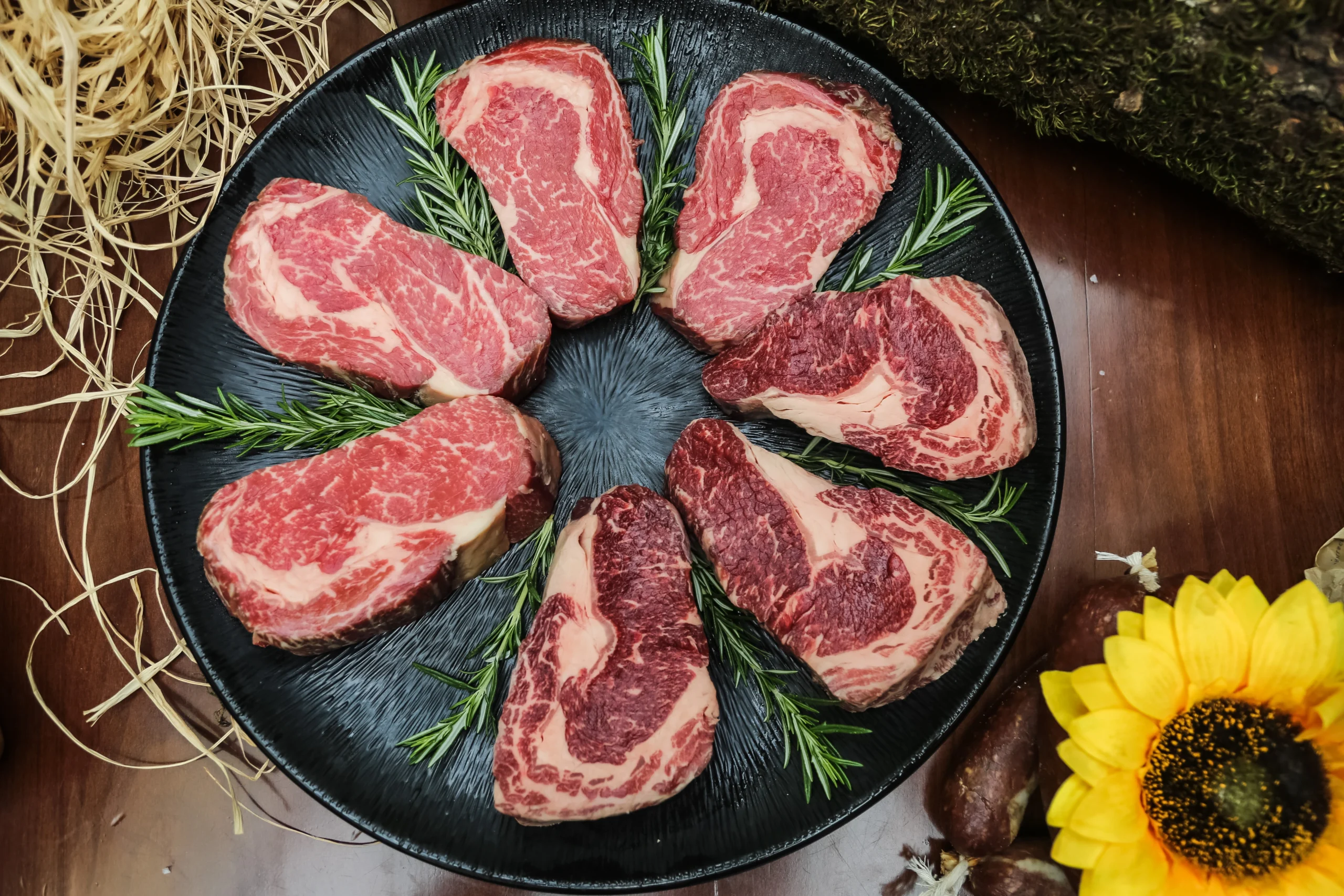
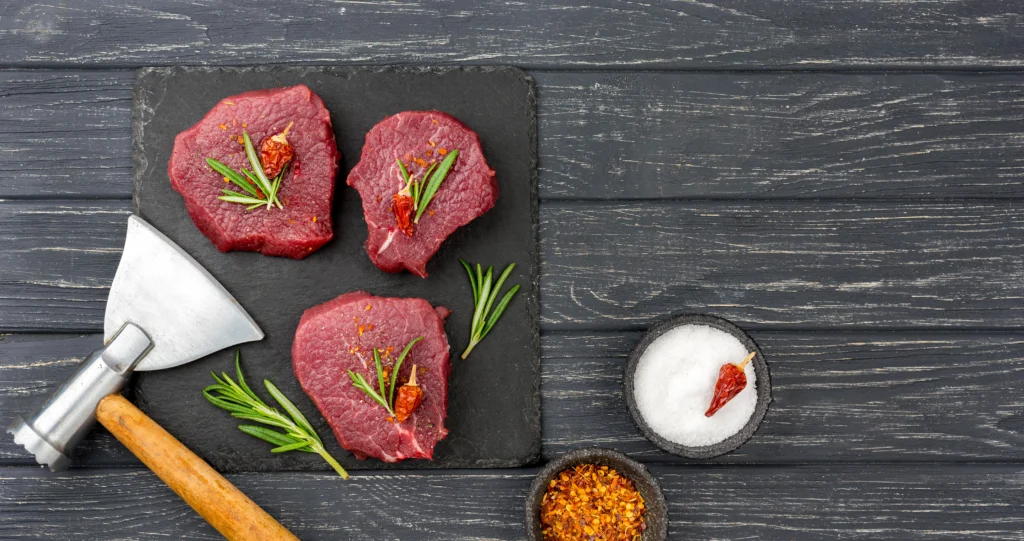
- Color: Raw top loin steak is a vibrant red, indicative of its freshness and high myoglobin content.
- Shape: Typically rectangular or slightly oval, depending on the cut.
- Size: Varies, but steaks are often cut to be about 1 to 2 inches thick.
- Texture: Firm and dense, with a fine grain structure that’s less marbled than ribeye but more so than sirloin, offering a balance of tenderness and flavor.
Culinary Uses
Top loin steak is highly versatile and well-regarded for its flavor and tenderness:
- Common Dishes: Grilled or broiled steaks, steak salads, steak sandwiches.
- Preparation Methods: Best cooked using high-heat methods such as grilling, broiling, or pan-searing to develop a flavorful crust while keeping the interior juicy and tender.
- Suitable Pairings: Complements robust sides like baked potatoes, grilled vegetables, or salads. Pairs well with butter, blue cheese, peppercorns, and robust sauces like béarnaise or red wine reductions.
Geographical Information
- Origin: Domestic cattle, a staple in human agriculture for thousands of years, originated in regions that are now Europe, Asia, and Africa.
- Primary Growing Regions: Beef is produced worldwide, with significant production in the United States, Brazil, the European Union, and China.
- Seasonal Availability: Available year-round due to controlled farming and livestock management practices.
The beef loin top loin steak, particularly when trimmed to 1/8″ fat and graded as choice, offers a high-quality option for a variety of dishes, balancing leanness with enough marbling to ensure flavor and juiciness. It’s a popular choice for both everyday meals and special occasions, providing essential nutrients and a rich, satisfying taste.
| Proximates: | |
| Water | 69.9 g |
| Energy (Atwater General Factors) | 149 kcal |
| Energy (Atwater Specific Factors) | 155 kcal |
| Protein | 22.8 g |
| Total lipid (fat) | 6.39 g |
| Total fat (NLEA) | 5.93 g |
| Ash | 1.01 g |
| Carbohydrates: | |
| Carbohydrate, by difference | 0 g |
| Minerals: | |
| Calcium, Ca | 15 mg |
| Iron, Fe | 1.9 mg |
| Magnesium, Mg | 11.3 mg |
| Phosphorus, P | 206 mg |
| Potassium, K | 282 mg |
| Sodium, Na | 45 mg |
| Zinc, Zn | 3.76 mg |
| Copper, Cu | 0.043 mg |
| Manganese, Mn | 0.002 mg |
| Selenium, Se | 21.3 µg |
| Vitamins and Other Components: | |
| Thiamin | 0.053 mg |
| Riboflavin | 0.202 mg |
| Niacin | 6.88 mg |
| Pantothenic acid | 0.36 mg |
| Pantothenic acid | 0.575 mg |
| Choline, total | 56.3 mg |
| Choline, free | 0.7 mg |
| Choline, from phosphocholine | 44 mg |
| Choline, from phosphotidyl choline | 0.7 mg |
| Choline, from glycerophosphocholine | 5.7 mg |
| Choline, from sphingomyelin | 5.2 mg |
| Betaine | 10 mg |
| Vitamin B-12 | 1.72 µg |
| Vitamin E (alpha-tocopherol) | 0.25 mg |
| Tocopherol, beta | 0 mg |
| Tocopherol, gamma | 0.02 mg |
| Tocopherol, delta | 0 mg |
| Tocotrienol, alpha | 0 mg |
| Tocotrienol, beta | 0 mg |
| Tocotrienol, gamma | 0 mg |
| Tocotrienol, delta | 0 mg |
| Vitamin D (D2 + D3), International Units | 0 IU |
| Vitamin D (D2 + D3) | 0 µg |
| Vitamin D2 (ergocalciferol) | 0 µg |
| Vitamin D3 (cholecalciferol) | 0 µg |
| 25-hydroxycholecalciferol | 0.26 µg |
| Lipids: | |
| Fatty acids, total saturated | 2.56 g |
| SFA 10:0 | 0.006 g |
| SFA 12:0 | 0.005 g |
| SFA 14:0 | 0.168 g |
| SFA 15:0 | 0.027 g |
| SFA 16:0 | 1.5 g |
| SFA 17:0 | 0.069 g |
| SFA 18:0 | 0.773 g |
| SFA 20:0 | 0.004 g |
| SFA 24:0 | 0.004 g |
| Fatty acids, total monounsaturated | 2.71 g |
| MUFA 14:1 c | 0.04 g |
| MUFA 16:1 c | 0.211 g |
| MUFA 17:1 | 0.054 g |
| MUFA 17:1 c | 0.054 g |
| MUFA 18:1 c | 2.39 g |
| MUFA 20:1 | 0.011 g |
| MUFA 20:1 c | 0.011 g |
| Fatty acids, total polyunsaturated | 0.364 g |
| PUFA 18:2 c | 0.281 g |
| PUFA 18:2 n-6 c,c | 0.259 g |
| PUFA 18:2 CLAs | 0.022 g |
| PUFA 18:3 c | 0.009 g |
| PUFA 18:3 n-3 c,c,c (ALA) | 0.009 g |
| PUFA 20:2 c | 0.001 g |
| PUFA 20:2 n-6 c,c | 0.001 g |
| PUFA 20:3 c | 0.013 g |
| PUFA 20:3 n-6 | 0.013 g |
| PUFA 20:4 | 0.048 g |
| PUFA 20:4c | 0.048 g |
| PUFA 20:5c | 0.003 g |
| PUFA 20:5 n-3 (EPA) | 0.003 g |
| PUFA 22:5 c | 0.008 g |
| PUFA 22:5 n-3 (DPA) | 0.008 g` |
| PUFA 22:6 c | 0 g |
| PUFA 22:6 n-3 (DHA) | 0 g |
| Fatty acids, total trans | 0.306 g |
| Fatty acids, total trans-monoenoic | 0.276 g |
| TFA 16:1 t | 0.015 g |
| TFA 18:1 t | 0.261 g |
| Fatty acids, total trans-dienoic | 0.03 g |
| TFA 18:2 t not further defined | 0.03 g |
| Cholesterol | 58 mg |