

Basic Information
- Common Name: Breakfast Sausage (Beef)
- Scientific Name: N/A (This is a processed meat product, not a single species.)
- Category: Food Product (Meat)
- Varieties: Breakfast sausages come in various types based on meat used, seasonings, and preparation methods. For beef breakfast sausages, variations may include differences in spice blends, sizes (links or patties), and fat content.
Nutritional Information
- Macronutrients (per 100 grams of beef breakfast sausage, pre-cooked, unprepared):
- Carbohydrates: 3.37 by difference
- Proteins: About 13.3 grams
- Fats: 18.7 grams, with a mix of saturated and unsaturated fats.
- Micronutrients: Provides iron, zinc, and B vitamins, particularly vitamin B12 and niacin.
- Calorie Count: Approximately 250-300 calories per 100 grams.
- Glycemic Index: Low, as it contains minimal carbohydrates.
Phytonutrients
Beef breakfast sausage, especially when pre-cooked and unprepared, is primarily a source of animal-based nutrients, including proteins and fats, and does not contain phytonutrients in the way that plant-based foods do. Phytonutrients are natural compounds found in plants, fruits, vegetables, grains, and legumes, known for their health benefits, such as antioxidant properties, anti-inflammatory effects, and potential to reduce the risk of certain chronic diseases.
Key Components in Beef Breakfast Sausage:
While beef breakfast sausage does not contain phytonutrients, it provides:
- Proteins: High-quality proteins that contain all essential amino acids necessary for muscle repair and growth.
- Fats: Saturated and unsaturated fats, including some trans fats depending on the cooking process and ingredients. Some sausages may contain omega-3 fatty acids but in much smaller amounts compared to fish and some plant oils.
- Vitamins and Minerals: Depending on the ingredients and seasoning, beef sausages can provide iron, zinc, phosphorus, vitamin B12, niacin (B3), and vitamin B6. These nutrients are important for various bodily functions, including oxygen transport, immune response, and energy metabolism.
Considerations:
- Sodium Content: Pre-cooked beef breakfast sausages tend to be high in sodium, which is a consideration for individuals monitoring their salt intake.
- Additives: Some pre-cooked sausages may contain additives and preservatives, such as nitrates or nitrites, which have been linked to health concerns when consumed in large amounts over time.
In summary, while beef breakfast sausage offers essential nutrients like protein and certain vitamins and minerals, it does not contain phytonutrients due to its animal origin. For individuals looking to increase their intake of phytonutrients, incorporating a variety of fruits, vegetables, whole grains, and legumes into the diet alongside animal products can provide a balanced spectrum of nutrients and health benefits.
Physical Characteristics
- Color: Light to dark brown, depending on the level of cooking and spices used.
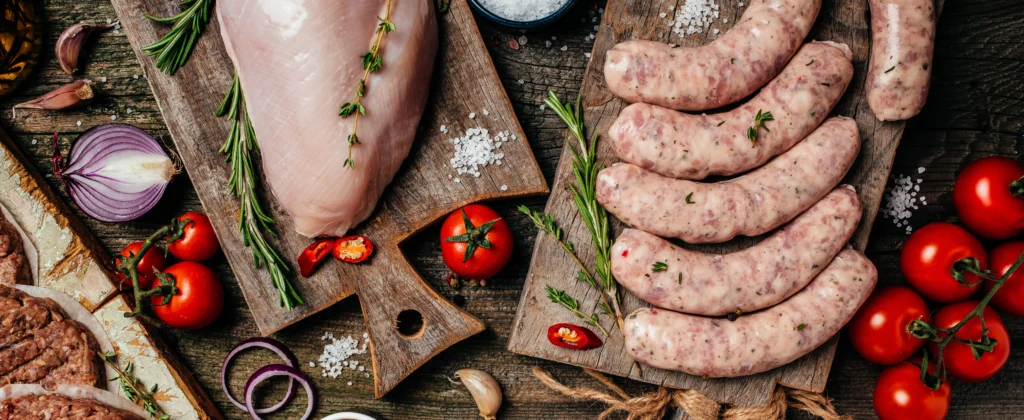
- Shape: Commonly found in cylindrical links or flattened patties.
- Size: Size can vary, with links typically being 2-4 inches long and patties 2-3 inches in diameter.
- Texture: Firm and slightly dense, with a juicy interior when properly cooked.
Culinary Uses
Beef breakfast sausages are a staple in many breakfast dishes:
- Common Dishes: Served alongside eggs, pancakes, or waffles; included in breakfast sandwiches or wraps; diced in omelets or breakfast scrambles.
- Preparation Methods: Can be pan-fried, grilled, or baked. Pre-cooked sausages only require reheating to a safe and palatable temperature.
- Suitable Pairings: Complements eggs, potatoes, toast, and breakfast grains like oatmeal or grits. Spices and herbs in the sausage pair well with savory and slightly sweet condiments.
Geographical Information
- Origin: Sausage making has ancient origins, with techniques and recipes developed across various cultures worldwide.
- Primary Growing Regions: As a meat product, the primary ingredient (beef) is sourced from cattle-raising regions globally, including the United States, Brazil, the European Union, and Australia.
- Seasonal Availability: Pre-cooked beef breakfast sausages are available year-round in supermarkets and food stores due to their processed nature and long shelf-life when frozen or refrigerated.
Beef breakfast sausages provide a convenient and flavorful protein option for morning meals, offering a satisfying start to the day. While they are a rich source of protein and certain micronutrients, mindful consumption is advised due to their high fat and calorie content, as well as sodium levels, which can vary significantly depending on the product.
| Proximates: | |
| Water | 51.7 g |
| Energy (Atwater General Factors) | 341 kcal |
| Energy (Atwater Specific Factors) | 346 kcal |
| Nitrogen | 2.13 g |
| Protein | 13.3 g |
| Total lipid (fat) | 28.7 g |
| Total fat (NLEA) | 27.1 g |
| Ash | 2.97 g |
| Carbohydrates: | |
| Carbohydrate, by difference | 3.37 g |
| Sugars, Total | 1 g |
| Glucose | 1 g |
| Minerals: | |
| Calcium, Ca | 35 mg |
| Iron, Fe | 1.55 mg |
| Magnesium, Mg | 19.7 mg |
| Phosphorus, P | 124 mg |
| Potassium, K | 263 mg |
| Sodium, Na | 866 mg |
| Zinc, Zn | 2.14 mg |
| Copper, Cu | 0.075 mg |
| Manganese, Mn | 0.174 mg |
| Selenium, Se | 11.6 |
| Vitamins and Other Components: | |
| Vitamin C, total ascorbic acid | 19.2 mg |
| Thiamin | 0.054 mg |
| Riboflavin | 0.132 mg |
| Niacin | 2.43 mg |
| Pantothenic acid | 0.322 mg |
| Vitamin B-6 | 0.15 mg |
| Choline, total | 38.3 mg |
| Choline, free | 2.3 mg |
| Choline, from phosphocholine | 27.7 mg |
| Choline, from phosphatidylcholine | 0.4 mg |
| Choline, from glycerophosphocholine | 1.9 mg |
| Choline, from sphingomyelin | 6 mg |
| Betaine | 2.8 mg |
| Vitamin B-12 | 1.13 |
| Vitamin A, RAE | 18 |
| Retinol | 18 |
| Vitamin E (alpha-tocopherol) | 0.33 |
| Tocopherol, gamma | 0.14 mg |
| Lipids: | |
| Fatty acids, total saturated | 11.3 g |
| SFA 4:0 | 0.004 g |
| SFA 10:0 | 0.002 g |
| SFA 12:0 | 0.018 g |
| SFA 14:0 | 0.784 g |
| SFA 15:0 | 0.105 g |
| SFA 16:0 | 6.66 g |
| SFA 17:0 | 0.256 g |
| SFA 18:0 | 3.47 g |
| SFA 20:0 | 0.027 g |
| SFA 22:0 | 0.004 g |
| SFA 24:0 | 0.003 g |
| Fatty acids, total monounsaturated | 12.7 g |
| MUFA 14:1 c | 0.253 g |
| MUFA 16:1 c | 1.1 g |
| MUFA 17:1 | 0.202 g |
| MUFA 17:1 c | 0.202 g |
| MUFA 18:1 c | 11 g |
| MUFA 20:1 c | 0.112 g |
| MUFA 22:1 c | 0.016 g |
| MUFA 22:1 n-9 | 0.016 g |
| MUFA 24:1 c | 0.002 g |
| Fatty acids, total polyunsaturated | 1.91 g |
| PUFA 18:2 c | 1.7 g |
| PUFA 18:2 n-6 c,c | 1.57 g |
| PUFA 18:2 CLAs | 0.128 g |
| PUFA 18:3 c | 0.094 g |
| PUFA 18:3 n-3 c,c,c (ALA) | 0.092 g |
| PUFA 18:3 n-6 c,c,c | 0.002 g |
| PUFA 18:4 | 0.001 g |
| PUFA 20:2 c | 0.033 g |
| PUFA 20:2 n-6 c,c | 0.033 g |
| PUFA 20:3 c | 0.031 g |
| PUFA 20:3 n-3 | 0.004 g |
| PUFA 20:3 n-6 | 0.028 g |
| PUFA 20:3 n-9 | 0 g |
| PUFA 20:4 | 0.046 g |
| PUFA 20:4c | 0.046 g |
| PUFA 22:5 c | 0.009 g |
| PUFA 22:4 | 0.015 g |
| PUFA 22:5 n-3 (DPA) | 0.009 g |
| PUFA 22:6 c | 0.002 g |
| PUFA 22:6 n-3 (DHA) | 0.002 g |
| Fatty acids, total trans | 1.18 g |
| Fatty acids, total trans-monoenoic | 1.08 g |
| TFA 16:1 t | 0.062 g |
| TFA 18:1 t | 1.02 g |
| Fatty acids, total trans-dienoic | 0.093 g |
| TFA 18:2 t not further defined | 0.093 g |
| Fatty acids, total trans-polyenoic | 0.002 g |
| TFA 18:3 t | 0.002 g |
| Cholesterol | 61 mg |
| Amino acids: | |
| Tryptophan | 0.12 g |
| Threonine | 0.5 g |
| Isoleucine | 0.46 g |
| Leucine | 0.93 g |
| Lysine | 0.95 g |
| Methionine | 0.26 g |
| Phenylalanine | 0.6 g |
| Tyrosine | 0.39 g |
| Valine | 0.53 g |
| Arginine | 0.83 g |
| Histidine | 0.35 g |
| Alanine | 0.77 g |
| Aspartic acid | 1.19 g |
| Glutamic acid | 1.89 g |
| Glycine | 0.94 g |
| Proline | 0.84 g |
| Serine | 0.55 g |
| Hydroxyproline | 0.29 g |
| Cysteine | 0.17 g |