
Basic Information
- Name: Mozzarella Cheese, Low Moisture, Part-Skim
- Scientific Name: Not applicable, as mozzarella is a type of cheese, not a species of plant or animal.
- Category: Dairy product
Varieties
While traditional mozzarella is fresh and high in moisture, low moisture, part-skim mozzarella is a variation that’s firmer and has less water content, making it suitable for cooking applications where less moisture is desired. It’s commonly available in several forms:
- Shredded: Pre-shredded for convenience, ideal for pizzas and casseroles.
- Block: Sold in solid blocks, which can be sliced or shredded as needed.
- String Cheese: Snack-sized portions, often used as a healthy snack.
Nutritional Information
Macronutrients
- Carbohydrates: Very low in carbohydrates.
- Proteins: A good source of protein, particularly because it’s made from part-skim milk.
- Fats: Lower in fat compared to whole milk mozzarella, due to the use of part-skim milk.
Micronutrients
- Vitamins: Contains Vitamin A and some B-vitamins, including riboflavin (B2) and niacin (B3).
- Minerals: Rich in calcium, which is essential for bone health, and provides phosphorus, zinc, and selenium.
phytonutrients
Mozzarella cheese, including the low moisture, part-skim variety, is a dairy product that primarily provides its nutritional value through macronutrients (fats, proteins, carbohydrates) and micronutrients (vitamins and minerals), rather than phytonutrients. Phytonutrients are compounds found in plant foods that offer various health benefits, including antioxidant and anti-inflammatory effects. Since mozzarella cheese is an animal-derived product, it does not contain phytonutrients, which are typically abundant in fruits, vegetables, grains, and other plant-based foods.
Nutritional Profile of Low Moisture, Part-Skim Mozzarella Cheese
While low moisture, part-skim mozzarella cheese lacks phytonutrients, it is nutritious and provides several important nutrients:
- Proteins: It is a good source of high-quality protein, which is essential for muscle repair and growth.
- Fats: This cheese has a lower fat content than its whole milk counterparts due to the use of part-skim milk. It still contains saturated fats but in reduced amounts.
- Vitamins: Contains Vitamin A and some B-vitamins, including riboflavin (B2) and niacin (B3), which are important for energy metabolism and skin health.
- Minerals: Rich in calcium, crucial for bone health, and also provides phosphorus, zinc, and selenium.
Health Considerations
Although mozzarella cheese does not provide phytonutrients, including a variety of fruits, vegetables, whole grains, nuts, and seeds in your diet alongside dairy products can ensure a broad intake of these beneficial compounds. Consuming low moisture, part-skim mozzarella cheese can contribute valuable proteins and calcium to your diet, making it a healthier choice due to its lower fat content compared to full-fat cheeses. However, it’s still advisable to consume cheese in moderation as part of a balanced diet, especially for individuals managing their intake of saturated fats and sodium.
Conclusion
Low moisture, part-skim mozzarella cheese is a flavorful and versatile ingredient suitable for many culinary applications, offering the benefits of protein and calcium. To maximize health benefits and ensure a diet rich in phytonutrients, it’s beneficial to pair cheese with plant-based foods that are high in these compounds. This approach allows for a diverse intake of essential nutrients, promoting overall health and well-being.
Calorie Count
Low moisture, part-skim mozzarella cheese is moderately high in calories, though lower than its whole milk counterpart due to reduced fat content.
Glycemic Index
Cheese, including low moisture, part-skim mozzarella, has a negligible glycemic index (GI) because it contains minimal carbohydrates.
Physical Characteristics
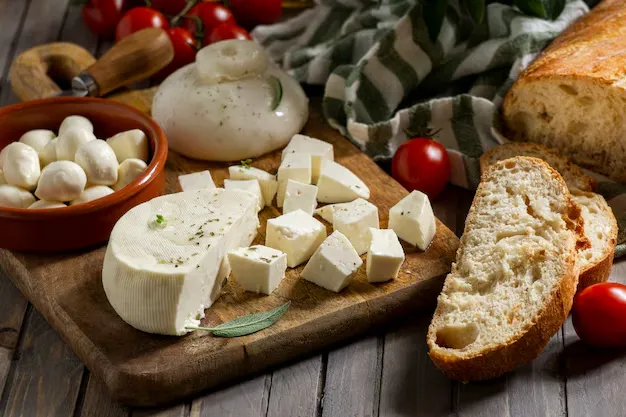
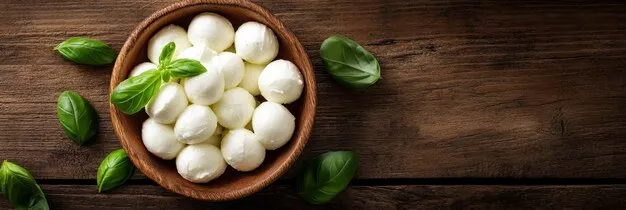
- Color: White to light yellow.
- Shape: Comes in blocks, shredded, or in string cheese form.
- Size: Size can vary based on the form it’s sold in (e.g., blocks, shredded, strings).
- Texture: Firmer and less moist than fresh mozzarella, with a slightly elastic texture when pulled or melted.
Culinary Uses
- Common Dishes: Widely used in pizzas, lasagnas, baked pasta dishes, and on top of salads for added protein.
- Preparation Methods: Can be used directly from the package; melts well and browns nicely under heat, making it ideal for baking and grilling.
- Suitable Pairings: Pairs well with tomatoes, basil, olive oil, and balsamic vinegar in caprese salads, as well as with a wide variety of meats, vegetables, and herbs in cooked dishes.
Geographical Information
- Origin: Mozzarella originates from Italy, but low moisture, part-skim mozzarella is more of an American adaptation designed for longer shelf life and better cooking properties.
- Primary Growing Regions: Produced extensively in the United States and in countries with significant dairy industries.
- Seasonal Availability: Available year-round.
Low moisture, part-skim mozzarella cheese is a versatile and popular cheese in both home kitchens and professional culinary settings, appreciated for its melting qualities and relatively healthier profile due to reduced fat content.
| proximates: | |
| Water | 47.7 g |
| Energy (Atwater General Factors) | 296 kcal |
| Energy (Atwater Specific Factors) | 298 kcal |
| Nitrogen | 3.71 g |
| Protein | 23.7 g |
| Total lipid (fat) | 20.4 g |
| Total fat (NLEA) | 17.8 g |
| Ash | 3.79 g |
| Carbohydrates: | |
| Carbohydrate, by difference | 4.44 g |
| Sugars, Total | 1.81 g |
| Sucrose | 0 g |
| Glucose | 0.3 g |
| Fructose | 0 g |
| Lactose | 0.66 g |
| Maltose | 0 g |
| Galactose | 0.86 g |
| Minerals: | |
| Calcium, Ca | 693 mg |
| Iron, Fe | 0.2 mg |
| Magnesium, Mg | 27.2 mg |
| Phosphorus, P | 533 mg |
| Potassium, K | 116 mg |
| Sodium, Na | 699 mg |
| Zinc, Zn | 3.62 mg |
| Copper, Cu | 0.035 mg |
| Manganese, Mn | 0.035 mg |
| Selenium, Se | 26.7 µg |
| Vitamins and Other Components: | |
| Thiamin | 0.023 mg |
| Riboflavin | 0.36 mg |
| Niacin | 0.101 mg |
| Pantothenic acid | 0.415 mg |
| Vitamin B-6 | 0.09 mg |
| Folate, total | 26 µg |
| Choline, total | 13.5 mg |
| Choline, free | 2.1 mg |
| Choline, from phosphocholine | 0.5 mg |
| Choline, from phosphatidylcholine | 4.8 mg |
| Choline, from glycerophosphocholine | 2.6 mg |
| Choline, from sphingomyelin | 3.6 mg |
| Betaine | 0.2 mg |
| Vitamin B-12 | 1.65 µg |
| Vitamin A, RAE | 203 µg |
| Retinol | 203 µg |
| Vitamin E (alpha-tocopherol) | 0.51 mg |
| Tocopherol, beta | 0 mg |
| Tocopherol, gamma | 0.04 mg |
| Tocopherol, delta | 0 mg |
| Tocotrienol, alpha | 0 mg |
| Tocotrienol, beta | 0 mg |
| Tocotrienol, gamma | 0 mg |
| Tocotrienol, delta | 0 mg |
| Vitamin K (phylloquinone | 1.3 mg |
| Vitamin K (Dihydrophylloquinone) | 0 mg |
| Vitamin K (Menaquinone-4) | 5.4 µg |
| Lipids: | |
| Fatty acids, total saturated | 11.7 g |
| SFA 4:0 | 0.396 g |
| SFA 6:0 | 0.334 g |
| SFA 8:0 | 0.209 g |
| SFA 10:0 | 0.509 g |
| SFA 11:0 | 0 g |
| SFA 12:0 | 0.583 g |
| SFA 14:0 | 1.89 g |
| SFA 15:0 | 0.199 g g |
| SFA 16:0 | 5.39 g |
| SFA 17:0 | 0.121 g |
| SFA 18:0 | 2.01 g |
| SFA 20:0 | 0.028 g |
| SFA 22:0 | 0.008 g |
| SFA 24:0 | 0.005 g |
| Fatty acids, total monounsaturated | 4.65 g |
| MUFA 14:1 c | 0.194 g |
| MUFA 15:1 | 0 g |
| MUFA 16:1 c | 0.265 g |
| MUFA 17:1 | 0.038 g |
| MUFA 17:1 c | 0.038 g |
| MUFA 18:1 c | 4.11 g |
| MUFA 20:1 | 0.038 g |
| MUFA 20:1 c | 0.038 g |
| MUFA 22:1 c | 0 g |
| MUFA 24:1 c | 0 g |
| Fatty acids, total polyunsaturated | 0.744 g |
| PUFA 18:2 c | 0.591 g |
| PUFA 18:2 n-6 c,c | 0.489 g |
| PUFA 18:2 CLAs | 0.102 g |
| PUFA 18:3 c | 0.076 g |
| PUFA 18:3 n-3 c,c,c (ALA) | 0.075 g |
| PUFA 18:3 n-6 c,c,c | 0.001 g |
| PUFA 18:3i | 0.002 g |
| PUFA 18:4 | 0 g |
| PUFA 20:2 c | 0.005 g |
| PUFA 20:2 n-6 c,c | 0.005 g |
| PUFA 20:3 c | 0.022 g |
| PUFA 20:3 n-3 | 0 g |
| PUFA 20:3 n-6 | 0.022 g |
| PUFA 20:3 n-9 | 0 g |
| PUFA 20:4 | 0.032 g |
| PUFA 20:4c | 0.032 g |
| PUFA 20:5c | 0.006 g |
| PUFA 20:5 n-3 (EPA) | 0.006 g |
| PUFA 22:2 | 0.001 g |
| PUFA 22:5 c | 0.012 g |
| PUFA 22:4 | 0.005 g |
| PUFA 22:5 n-3 (DPA) | 0.012 g |
| PUFA 22:6 c | 0 g |
| PUFA 22:6 n-3 (DHA) | 0 g |
| Fatty acids, total trans | 0.705 g |
| Fatty acids, total trans-monoenoic | 0.565 g |
| TFA 16:1 t | 0.061 g |
| TFA 18:1 t | 0.504 g |
| TFA 22:1 t | 0 g |
| Fatty acids, total trans-dienoic | 0.14 g |
| TFA 18:2 t not further defined | 0.14 g |
| Cholesterol | 65 mg |